Marketing performance in 2026 is no longer ruined by bad creatives or weak offers. It’s ruined by bad interpretation.
More specifically, by attribution models marketers get wrong — models that distort reporting while giving teams false confidence in decisions that don’t scale.
Attribution used to be simple because customer journeys were simple. Someone clicked an ad, landed on a page, converted, and everyone went home happy.
That reality no longer exists. Buyers now move across devices, platforms, formats, and time frames that most legacy attribution systems were never designed to interpret accurately.
What makes attribution especially dangerous today is that platforms still report with confidence, dashboards still show clean numbers, and marketers still make budget decisions based on them.
The problem isn’t lack of data. It’s misplaced trust in models that no longer reflect how conversions actually happen.
The attribution models marketers get wrong tend to fail in the same ways: they over-credit visible touchpoints, under-credit influence, and collapse complex journeys into neat but misleading conclusions.
In 2026, using the wrong model doesn’t just create reporting errors, it changes how campaigns are structured, optimized, and scaled.
To understand what works now, you have to understand why so many models fail, and what to replace them with.
What Attribution Models Are (And What They’re Supposed to Do)

Attribution models are systems used to assign credit for a conversion across the marketing touchpoints a user interacts with before taking action.
That action might be a purchase, a lead submission, a signup, or any defined conversion event.
In theory, attribution models exist to answer a simple question: which marketing efforts contributed to this outcome, and by how much?
In practice, attribution models translate messy, multi-touch customer journeys into structured data that platforms, dashboards, and decision-makers can act on.
Every time a report shows cost per acquisition, return on ad spend, or channel performance, an attribution model is deciding what counts, and what gets ignored.
This is where attribution models marketers get wrong start causing damage. Most models reduce complex behavior into simplified rules. Some prioritize timing.
Others prioritize position. Some rely on probabilistic machine learning. None of them capture reality perfectly, because reality isn’t linear, consistent, or platform-contained.
Attribution models also operate under constraints.
They depend on cookies, identifiers, tracking windows, and event definitions that are increasingly fragmented across devices and privacy frameworks.
When a user sees an ad on mobile, researches on desktop, and converts days later through a branded search, attribution models must guess how those moments connect.
That guess is not neutral. It shapes how performance is reported, which campaigns are labeled “winners,” and which channels get budget cuts.
Understanding what attribution models are, and what assumptions they rely on, is the first step in recognizing why so many attribution models marketers get wrong continue to dominate reporting in 2026.
Why Attribution Models Matter More Than Ever in 2026
Attribution models matter because they don’t just explain performance — they define it. In 2026, marketing teams rarely make decisions based on raw behavior.
They make decisions based on interpreted data, and attribution sits at the center of that interpretation.
Modern ad platforms are algorithm-driven. Google Ads, Meta, and other systems optimize delivery based on conversion feedback loops. If attribution data is distorted, the algorithms learn the wrong lessons.
Budgets shift toward channels that appear efficient rather than those that create real demand. Scaling decisions are made on false confidence.
This is why attribution models marketers get wrong are so dangerous today. The consequences aren’t limited to reporting errors.
They affect bidding strategies, creative direction, funnel design, and even product positioning. A flawed attribution model can quietly push an entire growth strategy off course while metrics appear healthy.
Privacy changes have amplified this problem. With shorter attribution windows, modeled conversions, and increased reliance on probabilistic data, attribution is now less observable and more inferred.
That makes the choice of model — and how its outputs are interpreted — more critical than ever.
Attribution also matters because it influences internal alignment.
Sales teams, content teams, and paid media teams often disagree not because performance differs, but because attribution models credit their work differently.
When leadership relies on attribution models marketers get wrong, internal incentives become misaligned, and optimization becomes political rather than data-driven.
In 2026, attribution models are no longer just analytical tools. They are decision frameworks. Getting them wrong doesn’t just misread the past — it misdirects the future.
#1. Last-Click Attribution Still Dominates (And Still Misleads)
Last-click attribution remains one of the most widely used attribution models marketers get wrong, largely because it’s easy to understand and universally supported across platforms.
The model assigns 100% of the conversion credit to the final interaction before a purchase or lead submission.
On paper, it feels objective. In practice, it hides almost everything that matters.
In modern funnels, the final click is rarely the reason someone converts. It’s often a branded search, a retargeting ad, or a direct visit — all actions that occur after awareness and consideration have already done the heavy lifting.
Last-click attribution rewards closers and punishes initiators, which leads marketers to cut top-of-funnel spend while over-investing in campaigns that simply harvest existing demand.
This becomes especially dangerous in ecosystems like Google Ads and Meta, where algorithmic bidding depends on accurate signals.
When last-click attribution feeds skewed data back into automated systems, those systems optimize toward shallow wins rather than sustainable growth.
Google itself has acknowledged these limitations and has progressively shifted advertisers toward data-driven attribution, noting that last-click ignores early touchpoints that can be critical to driving conversions.
In 2026, last-click attribution should only be used as a diagnostic lens, not a decision-making framework. It’s useful for identifying conversion closers, but useless for understanding demand creation.
Treating it as a primary model is one of the fastest ways to misallocate budget while believing performance is improving.
#2. First-Click Attribution Overcorrects the Problem
In response to last-click’s flaws, many marketers swing to the opposite extreme — and fall into another trap.
First-click attribution assigns all credit to the initial interaction that introduced a user to a brand. While this feels more respectful of awareness campaigns, it creates its own distortions.
First-click attribution assumes that discovery equals persuasion. In reality, the first touch often sparks curiosity, not commitment.
A user might see a display ad, scroll past a social post, or click a blog article without any purchase intent.
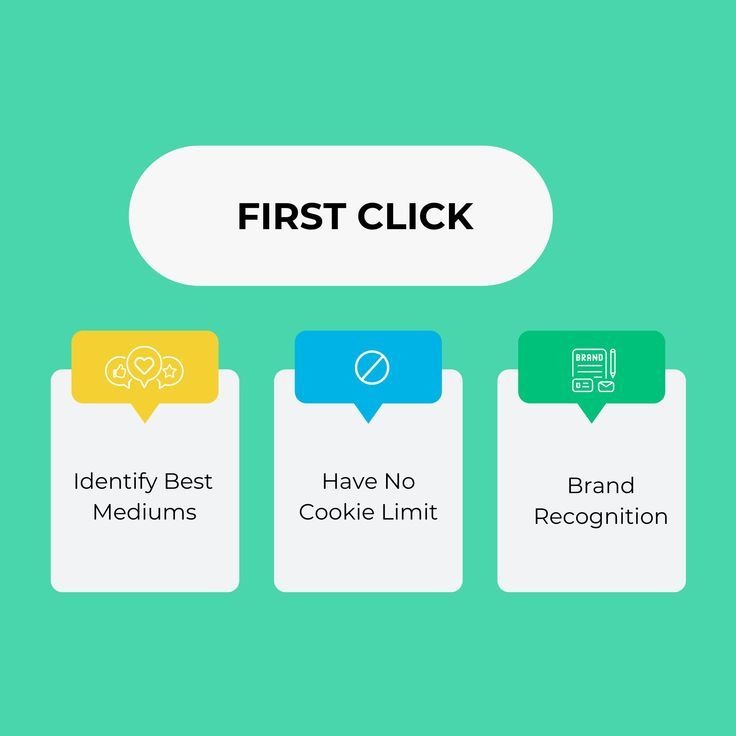
Assigning full credit to that moment exaggerates its impact while ignoring the work done by mid-funnel education, retargeting, and trust-building.
This model also performs poorly in long sales cycles and B2B environments, where multiple stakeholders interact with content over weeks or months.
Giving full credit to the first interaction oversimplifies journeys that are inherently cumulative.
According to HubSpot’s analysis of attribution modeling, first-click attribution “tends to inflate top-of-funnel channels while undervaluing those that actually drive conversion readiness”
Among attribution models marketers get wrong, first-click often appeals to content teams and brand strategists — but it creates optimization decisions that starve revenue-driving channels.
In 2026, it belongs in exploratory analysis, not performance reporting.
#3. Linear Attribution Treats All Touchpoints as Equal (They Aren’t)
Linear attribution attempts fairness by dividing credit equally across every interaction in a user’s journey.
While this sounds balanced, it introduces a different kind of inaccuracy: it assumes all touchpoints contribute equally to conversion.
They don’t.
A passive impression does not carry the same weight as a high-intent product demo. A scroll-by social ad does not influence behavior the same way a detailed comparison page does.
Linear attribution smooths out these differences until meaningful signals disappear into averages.
This model also struggles with journey inflation. The more touchpoints a user has, the more diluted each interaction becomes — regardless of its actual impact.
Channels that generate many low-impact touches look artificially valuable, while decisive interactions lose visibility.
Linear attribution is often used by teams attempting to avoid conflict between channels. Unfortunately, it replaces clarity with compromise.
As outlined in Nielsen’s attribution research, equal-weight models “fail to reflect true causal contribution and often mislead optimization decisions.”
Among attribution models marketers get wrong, linear attribution is the most diplomatic — and the least useful for growth.
#4. Time-Decay Attribution Assumes Recency Equals Influence
Time-decay attribution assigns more credit to touchpoints closer to the conversion, gradually reducing weight for earlier interactions.
This model attempts to balance influence while acknowledging momentum, but it rests on a flawed assumption: that recent interactions are inherently more persuasive.
In reality, earlier touchpoints often do the hardest work. They frame the problem, establish credibility, and set expectations.
Later interactions frequently function as reminders or confirmations rather than drivers of intent.
Time-decay attribution also varies wildly depending on the decay window chosen. A seven-day decay model tells a completely different story than a 30-day model — yet both appear mathematically sound.
This flexibility creates room for confirmation bias, where teams select windows that support existing beliefs.
While time-decay attribution can be useful for short sales cycles, it breaks down in complex journeys involving education, comparison, and trust. As customer paths become less linear, recency becomes a weaker proxy for influence.
Among attribution models marketers get wrong, time-decay often looks sophisticated while quietly reinforcing the same biases as last-click — just with nicer math.
#5. Position-Based Attribution Freezes Funnels in the Past
Position-based attribution (often called U-shaped attribution) assigns the most credit to the first and last touchpoints, with the remainder distributed across the middle.
Traditionally, this means 40% to first touch, 40% to last touch, and 20% to everything else.
This model was designed for a funnel that assumes clear stages: awareness, consideration, decision.
Modern buyer behavior doesn’t follow that structure. Users loop, pause, revisit, and switch devices. The “middle” is no longer a single phase — it’s a web of interactions with varying intent levels.
Position-based attribution also arbitrarily locks importance into fixed percentages. Why should first and last touches always matter most?
In some journeys, a mid-funnel webinar or case study is the decisive moment. Position-based models have no way to recognize that.
Position-based models impose structural assumptions that no longer align with real customer behavior.
Among attribution models marketers get wrong, position-based feels balanced but operates on outdated funnel logic.
#6. Platform-Reported Attribution Is Not Objective
One of the most dangerous attribution models marketers get wrong isn’t a model at all — it’s trusting platform-native reporting as truth.
Google Ads, Meta, TikTok, and LinkedIn all report conversions through their own attribution lenses, optimized to show their platform in the best possible light.
Each platform uses different lookback windows, engagement definitions, and modeling assumptions. Comparing them directly creates false conclusions.
A Meta conversion and a Google conversion are not equivalent events, even if they refer to the same user action. Treating them as such leads to double counting, inflated ROAS, and channel cannibalization.
Google explicitly states that conversion attribution may differ between platforms due to different attribution models and measurement methods.
In 2026, platform-reported attribution should be treated as directional, not definitive. It’s useful for in-platform optimization but unreliable for cross-channel decision-making.

#7. Blind Trust in Data-Driven Attribution Without Context
Data-driven attribution (DDA) is often positioned as the solution to all attribution problems — and while it is the most advanced option available, it is still one of the attribution models marketers get wrong when used without understanding its limits.
DDA uses machine learning to assign credit based on observed patterns across conversion paths. When implemented correctly, it outperforms rule-based models.
However, it depends heavily on data quality, volume, and tracking integrity. Sparse data, broken events, or inconsistent conversion definitions produce misleading outputs.
DDA also optimizes for correlation, not causation. It identifies patterns, not intent.
Without strategic interpretation, marketers risk outsourcing judgment entirely to algorithms that optimize for short-term efficiency rather than long-term growth.
Google notes that data-driven attribution requires sufficient conversion data to generate reliable results
In 2026, DDA works best when paired with human oversight, incrementality testing, and business context — not when treated as an oracle.
What Actually Works in 2026
The solution isn’t finding a perfect attribution model. It’s accepting that attribution is an estimation system, not a truth machine.
The most effective teams combine multiple approaches:
- Data-driven attribution for scalable optimization
- Incrementality testing to validate lift
- Platform reporting for tactical adjustments
- Business-level KPIs to anchor decisions in reality
Understanding which attribution models marketers get wrong allows you to stop chasing precision and start building clarity. The goal is not perfect attribution. The goal is better decisions.
In 2026, attribution maturity isn’t about choosing a model. It’s about knowing when not to trust one.