
Local visibility is no longer optional for small businesses. When someone searches for “plumber near me” or “best bakery in Lagos,” they are not browsing casually. They are looking for a solution close to them, and they are ready to act.
The businesses that appear in the top three local results — the Google Map Pack — capture the majority of those clicks. That positioning is rarely accidental. It is the outcome of structured, consistent local SEO tactics applied correctly over time.
Local search engine optimization differs from traditional SEO because it prioritizes geographic relevance. Google evaluates location signals, proximity, prominence, and relevance before ranking a business in local search results.
According to Google’s own business guidance, relevance, distance, and prominence are the three primary factors influencing local rankings. Businesses that align with these factors consistently outperform competitors in local queries.
Effective local SEO tactics combine Google Business Profile optimization, citation management, local keyword targeting, review generation, on-page local signals, and structured data implementation.
When implemented strategically, they drive more phone calls, direction requests, website visits, and in-store traffic. The following seven tactics break down exactly how local search works, what makes it effective, and how to implement it with precision.
#1. Optimize and Fully Build Out Your Google Business Profile

At the center of all local SEO tactics sits your Google Business Profile (formerly Google My Business). This listing feeds the Google Map Pack and directly influences local search visibility. Without optimization here, even strong websites struggle to rank in local queries.
Start by claiming and verifying your profile through Google Business Profile Manager.
Verification confirms legitimacy, which strengthens prominence signals. Next, complete every section accurately: primary category, secondary categories, business description, hours of operation, service areas, and attributes.
Choosing the correct primary category is critical. Google uses this as a primary relevance signal when ranking businesses for local keywords.
Consistency matters. Your business name, address, and phone number — commonly referred to as NAP — must match exactly across your website and third-party directories. Inconsistent citations dilute trust signals. According to Moz’s Local Ranking Factors study, citation consistency remains a significant ranking factor in local SEO.
Upload high-quality photos regularly. Businesses with updated photos receive more direction requests and engagement, based on Google’s own performance insights data. Use the Q&A feature proactively by posting common questions and answering them clearly. This strengthens keyword relevance while improving user experience.
Google Business Profile optimization is not a one-time task. It requires weekly updates, review responses, and periodic category adjustments. Strong local SEO tactics always treat GBP management as ongoing, not static.
#2. Conduct Strategic Local Keyword Research
Local SEO tactics are built on targeted local SEO keywords. These are search terms that combine services with geographic intent. Examples include “emergency electrician in Ikeja,” “best pediatric dentist near me,” and “affordable car repair Lagos Island.”
Local keyword research begins with tools like Google Keyword Planner and Google Search itself. Autocomplete suggestions and related searches reveal real search behavior. Pay close attention to “near me” queries, city-specific variations, and service-based combinations.
There are generally three keyword intent layers in local search optimization:
#1. Transactional local keywords (e.g., “hire roofing contractor in Abuja”)
#2. Informational local keywords (e.g., “how much does plumbing cost in Lagos?”)
#3. Navigational local keywords (e.g., business name searches)
Effective local SEO tactics map these keyword types to different pages. Service pages target transactional keywords. Blog posts handle informational queries. Contact pages reinforce navigational intent.
Incorporate local SEO keywords naturally in title tags, meta descriptions, headers, URL slugs, and body content. Add city modifiers, neighborhood names, and service areas where appropriate. Avoid keyword stuffing. Search engines evaluate semantic context and relevance, not repetition density alone.
Structured data markup further enhances local keyword targeting. Implement LocalBusiness schema using Schema.org guidelines to help search engines understand your business category, location, and services.
#3. Build and Manage Local Citations
Citations refer to online mentions of your business name, address, and phone number across directories and platforms. Examples include Yelp, Bing Places, Apple Maps, and local business directories.
Citations reinforce credibility and prominence. Search engines cross-reference these listings to confirm business legitimacy. Inconsistent information reduces ranking stability. That is why citation audits are foundational to strong local SEO tactics.
Begin by listing your business on major platforms such as:
#1. Yelp
#2. Bing Places
Next, expand to industry-specific directories. A dental clinic should appear on healthcare directories. A law firm should appear on legal directories. Relevance matters more than volume.
Regularly monitor citations to prevent duplicate listings. Duplicate entries split ranking authority and confuse search engines. Tools like BrightLocal and Whitespark are commonly used for citation management.
Local SEO tactics emphasize quality over quantity. Ten accurate, authoritative listings outperform fifty inconsistent ones.

#4. Strengthen On-Page Local Signals
On-page optimization remains one of the four core types of SEO, alongside off-page SEO, technical SEO, and local SEO. While local SEO tactics focus on geographic visibility, they rely heavily on strong on-page SEO foundations.
Include your city and service keywords in title tags and H1 headers. Add location-specific landing pages if you serve multiple areas. For example, a cleaning company serving both Lagos Mainland and Victoria Island should have separate optimized pages for each location.
Embed a Google Map on your contact page. This reinforces geographic relevance signals. Display your NAP clearly in the footer of every page. Use internal linking between service pages and location pages to distribute authority.
Mobile optimization is critical. According to Google’s mobile-first indexing documentation, Google primarily uses the mobile version of content for indexing and ranking. Since most local searches occur on mobile devices, responsive design is non-negotiable.
Technical SEO supports local SEO tactics. Fast load speed, secure HTTPS, clean URL structure, and proper indexing all contribute to better performance.
#5. Generate and Manage Online Reviews
Online reviews directly impact prominence and click-through rates. Google confirms that review count and review score influence local ranking (see Google Business Profile help documentation).
Encourage satisfied customers to leave reviews consistently. Do not incentivize reviews in ways that violate Google’s policies. Instead, request feedback after successful service completion via email or SMS.
Respond to every review. Acknowledge positive feedback and address negative comments professionally. Review responses show engagement, which strengthens trust signals.
Include relevant local SEO keywords naturally in responses where appropriate. For example, “Thank you for trusting our plumbing services in Surulere” reinforces location signals.
Reviews also influence conversion rates. BrightLocal’s consumer survey reports that most consumers read online reviews before visiting a local business. Strong local SEO tactics treat review management as both a ranking factor and a conversion tool.
6. Understand the Three Pillars of Local SEO
Local rankings are influenced by three pillars: relevance, distance, and prominence. Google publicly confirms this framework in its business ranking documentation.
#1. Relevance refers to how well your business matches a search query.
#2. Distance measures the proximity between the searcher and your business location.
#3. Prominence reflects how well-known and authoritative your business is online.
Local SEO tactics improve relevance through keyword optimization and accurate categories. Distance cannot be controlled directly, but service-area optimization can expand reach. Prominence is strengthened through backlinks, citations, reviews, and brand mentions.
Backlinks from local news sites, blogs, and chambers of commerce improve authority. For example, being featured on a reputable local publication increases prominence signals significantly.
These pillars work together. Even the best-optimized listing will struggle without prominence. Even strong backlinks will not compensate for incorrect categories.
#7. Use AI Strategically for Local SEO
Artificial intelligence tools are transforming how businesses implement local SEO tactics. AI assists in keyword clustering, content creation, review sentiment analysis, and competitor research.
AI-powered tools can analyze competitor Google Business Profiles to identify category gaps and keyword opportunities. They can also generate optimized location-based content aligned with semantic search intent.
Use AI to identify search trends in your region. For example, analyzing local query variations helps tailor landing pages more precisely. AI can also automate review response drafts while maintaining personalization.
However, automation must be supervised. Over-automation can create generic content that weakens trust signals. Local SEO tactics benefit from AI insights but still require human oversight.
Can You Do Local SEO Without a Website?
Yes, but with limitations. A fully optimized Google Business Profile can rank in the Map Pack even without a website. Many small service providers operate successfully using only their GBP listing.
This works particularly well for electricians, plumbers, mobile barbers, and other service-area businesses where customers primarily call directly from search results. If you choose this route, your local SEO tactics must focus heavily on category precision, service descriptions, review generation, photo uploads, and consistent posting within GBP.
You should also complete every attribute, define service areas clearly, and answer questions inside the Q&A section to strengthen relevance signals.
However, a website strengthens relevance and prominence significantly. It allows deeper keyword targeting, blog content creation, backlink acquisition, and structured data implementation.
Without a website, you cannot rank for broader informational local queries or build topical authority. You are also limited in tracking analytics and conversion data. Local SEO tactics become more scalable and defensible when GBP optimization is reinforced by a well-optimized website that supports long-term growth rather than short-term visibility.
Local SEO tactics are more powerful when GBP optimization and website SEO work together. When both are aligned, Google can cross-verify location signals, keywords, and authority indicators.
For example, if your website’s service page targets “roof repair in Yaba” and your Google Business Profile lists Yaba as a service area, relevance strengthens. Embedding your Google Map on your contact page, marking up your business with LocalBusiness schema, and ensuring NAP consistency across your site reinforce trust signals.
A website also allows internal linking between service pages and location pages, which improves crawlability and distributes authority across important URLs.
Blog content can target long-tail local SEO keywords such as “cost of roof repair in Yaba,” capturing search traffic that a standalone GBP listing cannot rank for. Meanwhile, backlinks earned through local sponsorships or partnerships boost prominence, which supports Map Pack rankings indirectly.
When these layers operate together, local SEO tactics move beyond visibility and start creating predictable lead generation. GBP drives immediate calls. The website captures organic traffic. Combined, they create a stronger, more defensible local presence.
What a Strong Local SEO Checklist Includes
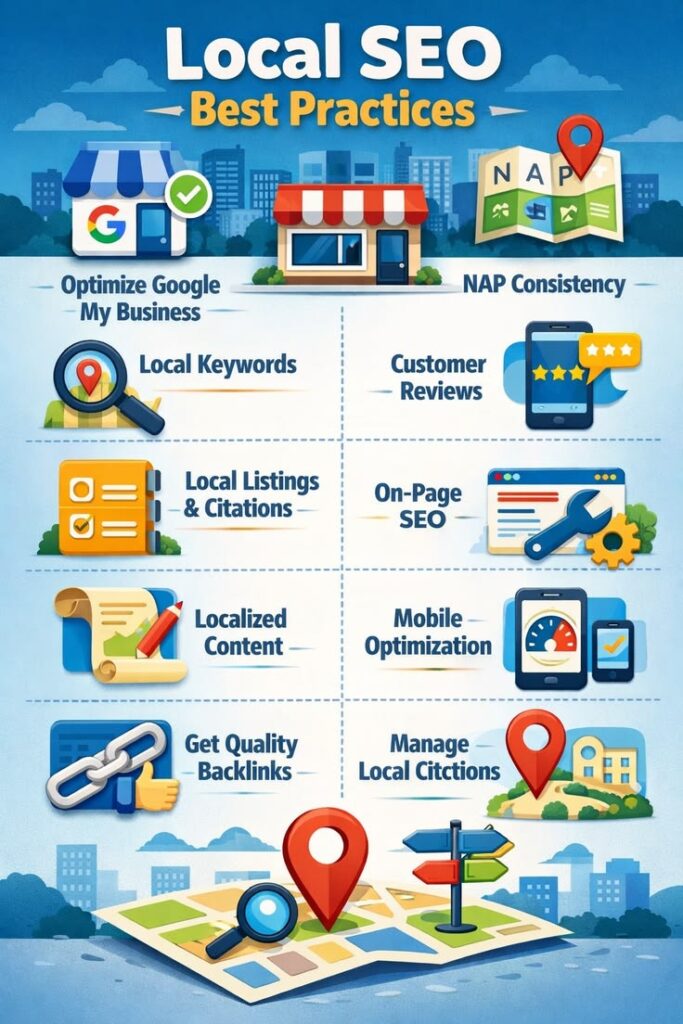
A reliable local SEO checklist includes structured, repeatable steps that align directly with ranking factors. Google Business Profile verification and optimization come first. This means selecting the correct primary category, adding secondary categories, uploading real photos, defining service areas, and posting updates regularly.
Next comes a NAP consistency audit. Your business name, address, and phone number must match exactly across directories, social profiles, and your website.
Local keyword research ensures your service pages align with search intent. Identify transactional keywords with city modifiers and map them to specific landing pages.
On-page SEO with location pages means optimizing title tags, H1s, and meta descriptions with geographic signals while avoiding keyword stuffing. Structured data implementation using LocalBusiness schema clarifies business details for search engines.
Citation building strengthens prominence. A review generation strategy builds trust and improves click-through rates. Mobile optimization and page speed improvements ensure strong user experience signals.
Finally, local backlink outreach — such as partnerships with community organizations — builds authority. Each component supports different ranking signals. Skipping one weakens the entire framework and slows the effectiveness of your local SEO tactics.
How Local SEO Works in Practice
Local SEO works by aligning business signals with search engine ranking algorithms. When a user enters a geographically influenced query, Google evaluates relevance, proximity, and authority signals simultaneously.
Relevance is determined by how closely your categories, services, and content match the query. Proximity is influenced by the searcher’s physical location or specified location terms. Authority, often referred to as prominence, is built through reviews, backlinks, citations, and brand mentions.
Algorithms assess structured data, business categories, user engagement, reviews, backlinks, and citation consistency. They cross-reference these signals with user location data and search intent.
For example, if someone searches “emergency dentist near me” at 9 p.m., Google prioritizes verified dental clinics marked as open, located nearby, and supported by strong review profiles. Businesses that align across all layers rank higher because their signals reduce ambiguity.
Unlike national SEO, local search relies heavily on trust verification. Accurate business data across platforms reduces confusion. Strong review profiles increase credibility. Localized content reinforces relevance.
These coordinated local SEO tactics create ranking momentum over time, making visibility more stable and predictable rather than fluctuating randomly.
Conclusion
Local visibility drives measurable business growth. Businesses that implement structured, consistent local SEO tactics outperform competitors in search results, map listings, and customer acquisition.
Optimized Google Business Profiles, accurate citations, strategic local keyword research, review management, structured data, and AI-assisted insights all work together. These are not isolated tactics. They are components of an integrated local search strategy.
When executed correctly, local SEO tactics increase calls, bookings, store visits, and revenue. For small businesses competing in crowded markets, disciplined local optimization is not optional. It is foundational.