
Marketing today is a multi-touch journey. A potential customer might see a social media post, click a paid ad, read a blog article, and finally convert through an email campaign.
Without a clear system to track which touchpoints truly influenced the sale, businesses end up guessing where their marketing success comes from.
That’s where a marketing attribution model becomes essential.
A marketing attribution model helps businesses identify which marketing channels deserve credit for conversions.
Instead of assuming the last click is responsible for the sale, attribution models analyze the entire customer journey and assign value to different interactions.
For marketers, this insight is powerful. It reveals which campaigns actually move customers closer to conversion, which channels waste budget, and where future investments should go.
Companies that rely on guesswork often overspend on channels that appear successful but contribute little to real revenue.
In contrast, brands that use a structured marketing attribution model gain a deeper understanding of customer behavior and make smarter marketing decisions backed by data.
Understanding how attribution works—and choosing the right model—can dramatically improve marketing ROI, campaign performance, and long-term growth.
What Is a Marketing Attribution Model?
A marketing attribution model is a framework used to determine how credit for conversions is distributed across different marketing touchpoints in a customer’s journey.
When someone eventually buys a product or signs up for a service, they likely interact with several marketing channels along the way.
Attribution modeling helps marketers analyze those interactions and determine which ones had the most influence.
For example, a typical buyer journey might look like this:
#1. A user sees a Facebook ad.
#2. They search on Google and click an organic result.
#3. They read a blog post.
#4. They sign up for an email list.
#5. They later click an email promotion and purchase.
Without attribution modeling, marketers might give all credit to the email campaign. However, the Facebook ad and blog content may have played a crucial role in introducing and nurturing the customer.
A marketing attribution model assigns weighted value to these interactions so marketers can understand which channels contribute to conversions.
This insight allows businesses to:
#1. Allocate budgets more effectively
#2. Improve campaign strategies
#3. Identify high-performing channels
#4. Optimize the full customer journey
In short, attribution modeling transforms scattered marketing data into actionable insights.
Why Marketing Attribution Matters in Modern Marketing
Marketing attribution has become increasingly important because the modern buyer journey is no longer linear.
Consumers now interact with brands across multiple channels, including:
#1. Social media
#2. Paid advertising
#3. Organic search
#4. Email marketing
#5. Influencer marketing
#6. Content marketing
#7. Video platforms
Without a marketing attribution model, marketers risk making decisions based on incomplete information.
For example, a brand might believe paid ads drive most conversions because those ads often appear as the final click.
However, deeper analysis may reveal that blog articles or social media posts introduced customers to the brand first.
Attribution modeling helps marketers understand:
#1. True ROI of marketing channels
It shows which campaigns generate real business value, not just clicks or impressions.
#2. Customer journey patterns
Marketers can identify the touchpoints that consistently appear before conversions.
#3. Budget optimization opportunities
Resources can be shifted toward channels that actually influence buying decisions.
#4. Campaign performance improvements
Understanding attribution allows marketers to refine messaging, targeting, and timing.
Businesses that invest in attribution analysis often discover that their most influential channels are not the ones receiving the largest budgets.
9 Powerful Marketing Attribution Model Strategies That Drive Better Results
Choosing the right attribution strategy can transform marketing performance.
Below are some of the most effective approaches marketers use to understand conversion paths.
#1. First-Touch Attribution
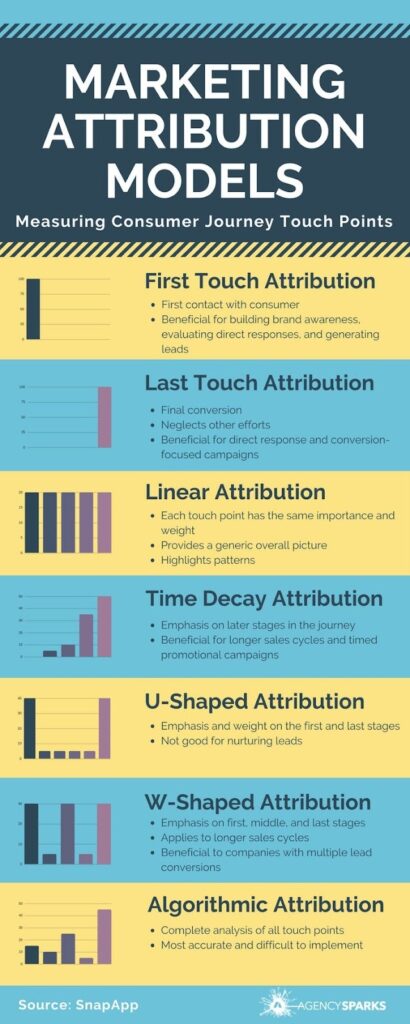
First-touch attribution gives 100% credit for a conversion to the first interaction a customer has with a brand.
For example, if someone first discovers a brand through a blog post and later converts via email, the blog post receives all the credit.
This model is particularly useful for understanding:
#1. Brand awareness channels
#2. Top-of-funnel marketing effectiveness
#3. Lead generation sources
However, it ignores later interactions that help nurture and convert the customer.
#2. Last-Touch Attribution
Last-touch attribution assigns all credit to the final interaction before the conversion.
This model is commonly used in many analytics tools because it is simple and easy to implement.
For example:
#1. A customer reads several articles
#2. Joins an email list
#3. Finally clicks a promotional email and purchases
Under last-touch attribution, the email campaign receives full credit.
While simple, this approach often undervalues earlier marketing efforts that influenced the customer.
#3. Linear Attribution Model
The linear attribution model distributes credit equally across every touchpoint in the customer journey.
If a customer interacts with five marketing channels before converting, each one receives 20% credit.
This model provides a more balanced view of marketing performance because it acknowledges that multiple interactions contribute to the final decision.
However, it assumes that every interaction has equal influence, which may not always be accurate.
#4. Time-Decay Attribution
Time-decay attribution assigns more credit to touchpoints closer to the conversion event.
Interactions that happen earlier in the journey still receive credit, but their influence gradually decreases over time.
For example:
#1. Social media discovery: 10% credit
#2. Blog article: 20% credit
#3. Email campaign: 30% credit
#4. Retargeting ad before purchase: 40% credit
This model works well for businesses with longer sales cycles where recent interactions tend to have greater influence.
#5. Position-Based Attribution (U-Shaped Model)
Position-based attribution gives the most credit to the first and last touchpoints, while distributing the remaining credit among middle interactions.
A common structure looks like this:
#1. 40% credit to the first interaction
#2. 40% credit to the final interaction
#3. 20% distributed among middle touchpoints
This model recognizes that both discovery and final conversion actions are crucial to the buying process.
#6. Data-Driven Attribution
Data-driven attribution uses algorithms and machine learning to assign credit based on actual user behavior and conversion patterns.
Instead of applying a fixed formula, the model analyzes large datasets to determine which touchpoints contribute the most to conversions.
This approach offers several advantages:
#1. More accurate credit distribution
#2. Adaptability across different campaigns
#3. Improved optimization insights
However, it typically requires large datasets and advanced analytics tools.
#7. Multi-Touch Attribution
Multi-touch attribution evaluates the entire customer journey and distributes credit across multiple interactions.
Unlike simpler models that focus on only one touchpoint, multi-touch analysis considers the combined influence of all marketing channels.
Businesses using multi-touch attribution often discover surprising insights, such as:
#1. Content marketing driving early discovery
#2. Retargeting ads reinforcing purchase intent
#3. Email campaigns closing conversions
This comprehensive view helps marketers optimize their strategies across the full funnel.
#8. Cross-Channel Attribution Strategy
Cross-channel attribution focuses on how different marketing platforms work together.
For example, a typical path might include:
#1. Instagram ad
#2. Google search
#3. Blog content
#4. Email marketing
#5. Paid retargeting
Analyzing these interactions together reveals how channels support each other rather than competing for credit.
Brands that adopt cross-channel attribution often improve coordination between marketing teams and campaigns.
#9. Custom Attribution Modeling
Custom attribution models allow businesses to create their own rules for assigning credit based on specific marketing goals.
For example:
#1. A SaaS company may emphasize lead generation channels
#2. An e-commerce store may prioritize conversion-driving campaigns
#3. A B2B company may weight long-term nurturing touchpoints more heavily
Custom models provide the highest level of flexibility and often produce the most relevant insights for complex marketing strategies.
How to Choose the Right Marketing Attribution Model
Selecting the right marketing attribution model depends on several factors, including business size, marketing channels, and available data.
Here are key considerations when choosing a model:
Business goals
If brand awareness is the priority, first-touch attribution may be useful. If conversions are the focus, last-touch or time-decay models may be more appropriate.
Sales cycle length
Businesses with longer sales cycles often benefit from multi-touch or data-driven models that capture the full journey.
Data availability
Advanced models require significant data and analytics capabilities.
Marketing complexity
Companies running campaigns across many platforms should consider cross-channel or multi-touch attribution.
Many organizations start with simple models and gradually transition to more advanced approaches as their analytics capabilities mature.

Tools That Help Implement Attribution Modeling
Several marketing tools support attribution analysis and reporting.
Popular options include:
#1. Google Analytics
#2. HubSpot
#3. Adobe Analytics
#4. Salesforce Marketing Cloud
#5. Attribution-specific analytics platforms
These tools help marketers track user journeys, analyze channel performance, and visualize how different campaigns contribute to conversions.
Using the right technology ensures that attribution insights remain accurate and actionable.
Common Challenges in Marketing Attribution
Although attribution modeling offers valuable insights, marketers often face several challenges when implementing it.
Data fragmentation
Customer interactions occur across multiple platforms, making it difficult to track every touchpoint accurately.
Cross-device behavior
Users frequently switch between devices, complicating attribution tracking.
Offline conversions
Some purchases occur offline, making it harder to attribute them to digital marketing activities.
Privacy regulations
Increasing privacy restrictions limit the ability to track user behavior across websites and platforms.
Despite these challenges, attribution modeling remains one of the most effective ways to understand marketing performance.
Conclusion
A well-implemented marketing attribution model provides marketers with a clear understanding of how different campaigns influence customer decisions.
Instead of relying on assumptions, businesses can use attribution insights to:
#1. Allocate marketing budgets more effectively
#2. Improve campaign targeting and messaging
#3. Optimize the entire customer journey
#4. Increase overall marketing ROI
As digital marketing ecosystems continue to grow more complex, attribution modeling will play an even more critical role in guiding data-driven decisions.
Companies that master attribution today position themselves to build smarter strategies, stronger campaigns, and more sustainable growth in the future.