Marketing today is messy but in a good way. Customers don’t just “see ads → buy products” anymore. They lurk, scroll, compare, forget you, rediscover you, and then maybe buy.
If you’re only tracking the last click, you’re basically giving all the credit to the closing scene and ignoring the entire movie.
That’s why multi-touch attribution has become a game-changer.
Multi-touch attribution helps marketers understand how every interaction—ads, emails, content, social posts—contributes to a conversion.
Instead of rewarding one channel, it maps the entire customer journey and assigns value across touchpoints.
It sits at the intersection of digital marketing attribution, brand attribution, and advanced attribution models, giving businesses a complete view of what actually drives results.
What Is Multi-Touch Attribution?
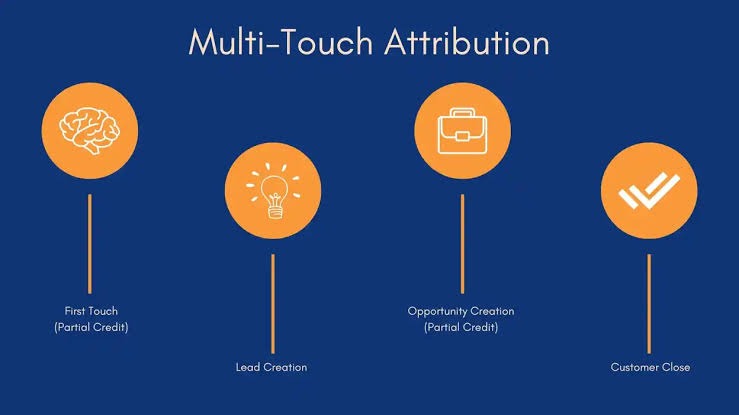
Multi-touch attribution is an attribution model that distributes credit for a conversion across multiple touchpoints in the customer journey, instead of giving all the credit to a single interaction.
In reality, customers rarely convert after just one touch. They move through a series of interactions—some subtle, some direct—before making a decision.
Instead of assigning 100% credit to the first or last click, multi-touch attribution recognizes that different marketing efforts work together to influence outcomes.
It captures the complexity of real-world behavior.
For example:
A user sees an Instagram ad → reads a blog post → searches your brand on Google → joins your email list → clicks a promotional email → makes a purchase.
A multi-touch attribution model assigns value to each of these interactions, not just the final click.
This creates a more balanced and realistic view of performance, making it one of the most accurate approaches within digital marketing attribution for understanding how conversions actually happen.
What Is Multi-Touch Attribution in Digital Marketing?
In the context of digital marketing attribution, multi-touch attribution refers to tracking, connecting, and analyzing how different marketing channels collectively influence conversions across the entire funnel.
It moves beyond isolated metrics and focuses on how channels interact with each other.
Rather than asking “What closed the sale?”, it asks smarter questions:
#1. Which channels introduced customers to your brand?
#2. Which touchpoints built trust and nurtured interest?
#3. Which interactions finally pushed users to convert?
This approach provides a full-funnel perspective—from awareness to consideration to decision.
It also bridges the gap between brand attribution (which focuses on visibility and awareness) and performance metrics like leads, sales, and revenue.
By using multi-touch attribution, marketers can see how content, ads, search, and email campaigns work together instead of competing for credit.
The result? A clearer, more strategic understanding of what’s actually driving growth within your attribution model.
Why Multi-Touch Attribution Matters
Modern customer journeys are anything but linear.
The average user interacts with multiple channels before converting, including social media, search engines, email campaigns, paid ads, blog content, and even influencer recommendations.
Each touchpoint plays a role—some introduce your brand, others build trust, and a few drive the final decision.
Without multi-touch attribution, marketers rely on incomplete or misleading data. Most traditional models—especially last-click—overvalue the final interaction while ignoring everything that came before it.
That’s like giving all the credit to the cashier and ignoring the entire sales team.
Multi-touch attribution changes that by offering:
#1. Better visibility: You see the full customer journey, not just isolated moments.
#2. Accurate ROI tracking: You understand which channels actually contribute to conversions—not just the obvious ones.
#3. Smarter decisions: You invest in what truly works, instead of what seems to work.
#4. Stronger strategies: You optimize across the entire funnel, from awareness to conversion, using real data—not assumptions.
7 Powerful Multi-Touch Attribution Strategies
Different approaches to multi-touch attribution help businesses analyze customer journeys more effectively by assigning value to key interactions across the funnel.
Choosing the right attribution model depends on your goals, sales cycle, and how complex your marketing ecosystem is.
#1. Linear Attribution Model
The linear attribution model distributes credit equally across all touchpoints in the customer journey. If a customer interacts with five channels, each receives 20% of the credit for the conversion.
This approach is straightforward and ensures that no interaction is ignored. Every touchpoint—whether it’s a social media ad, blog post, or email—gets acknowledged as part of the conversion process.
However, the trade-off is simplicity over precision. The model assumes that every interaction has equal influence, which isn’t always realistic.
Still, it’s a great starting point for businesses new to multi-touch attribution, especially those looking to move beyond last-click models and gain a broader view of their digital marketing attribution efforts.
#2. Time-Decay Attribution
Time-decay attribution gives more credit to touchpoints that occur closer to the conversion, while still assigning some value to earlier interactions.
The closer a touchpoint is to the final action, the more influence it is assumed to have.
This model works well for businesses with longer sales cycles, where customers may interact with multiple channels over days or weeks before converting.
It reflects the idea that while early-stage interactions (like brand attribution) create awareness, later touchpoints play a stronger role in driving decisions.
Time-decay attribution is particularly useful in digital marketing attribution when retargeting campaigns, follow-up emails, or product reminders are key drivers of conversions.
It offers a more realistic weighting system than linear models without becoming overly complex.
#3. Position-Based Attribution (U-Shaped)
The position-based attribution model, often called the U-shaped model, emphasizes the importance of both the first and last interactions in the customer journey.
Typically, it assigns:
#1. 40% credit to the first touch (awareness)
#2. 40% credit to the last touch (conversion)
#3. 20% distributed among middle interactions
This structure balances brand attribution with conversion-focused tracking. The first interaction gets credit for introducing the customer to your brand, while the last interaction is recognized for closing the deal.
The middle touchpoints still matter, but they receive less weight.
This makes the model ideal for businesses that want to highlight acquisition and conversion while still acknowledging the supporting role of nurturing efforts within their multi-touch attribution strategy.

#4. W-Shaped Attribution
The W-shaped attribution model builds on the U-shaped approach by assigning significant credit to three critical stages in the customer journey:
#1. First interaction (awareness)
#2. Lead creation (engagement)
#3. Final conversion (decision)
Each of these stages typically receives around 30% of the credit, with the remaining 10% distributed among other touchpoints.
This model is especially useful for B2B businesses and companies with structured funnels, where lead generation is a key milestone.
It highlights not just how customers find you and convert, but also when they officially enter your pipeline.
Within multi-touch attribution, the W-shaped model provides a more nuanced view of the journey, aligning closely with both digital marketing attribution and sales processes.
#5. Full-Path Attribution
Full-path attribution takes the W-shaped model a step further by including post-conversion interactions, giving a complete view of the entire customer lifecycle.
In addition to the first touch, lead creation, and final conversion, this model also factors in stages like customer onboarding, retention, and repeat purchases.
This makes it one of the most comprehensive forms of multi-touch attribution.
It’s particularly valuable for subscription-based businesses, SaaS companies, and brands focused on long-term customer value.
Instead of stopping at the sale, it tracks how marketing continues to influence customer behavior after conversion.
By combining brand attribution, conversion tracking, and retention analysis, full-path attribution provides deep insights into how marketing drives both immediate and long-term growth.
#6. Data-Driven Attribution
Data-driven attribution is one of the most advanced forms of multi-touch attribution, using machine learning and algorithms to analyze real customer behavior instead of relying on fixed rules.
Rather than assigning equal weight or predefined percentages, it evaluates patterns in your data to determine which touchpoints actually influence conversions.
For example, it may discover that users who engage with a specific blog post and then receive a follow-up email are significantly more likely to convert. Based on this, it assigns more credit to those interactions.
This model continuously adapts as new data comes in, making it highly accurate and responsive to changing user behavior. Within digital marketing attribution, data-driven models provide deeper insights, helping businesses move beyond assumptions and base decisions on real performance trends.
#7. Custom Attribution Models
Custom attribution models give businesses full control over how credit is assigned across the customer journey.
Instead of relying on predefined structures, companies can build an attribution model that aligns with their specific goals, sales process, and customer behavior.
For example:
#1. E-commerce brands may prioritize conversion-focused touchpoints like product pages and retargeting ads
#2. SaaS companies may emphasize lead generation, demos, and email nurturing sequences
This flexibility makes custom models particularly valuable for complex marketing ecosystems where standard models fall short.
They allow businesses to reflect both brand attribution and performance-driven metrics in a way that matches their strategy.
Within multi-touch attribution, custom models offer the most tailored insights, but they require strong data, clear objectives, and ongoing optimization to remain effective.
How Does Multi-Touch Attribution Work?
Multi-touch attribution works by collecting data from multiple marketing channels and mapping out the full customer journey to understand how each interaction contributes to a conversion.
Instead of analyzing channels in isolation, it connects them into a single, cohesive path.
Here’s how it typically functions:
1. Data collection
Tracking tools gather data from ads, websites, email campaigns, search engines, and social platforms, capturing every interaction a user has with your brand.
2. User journey mapping
Each touchpoint is stitched together to form a unified journey, showing how users move from awareness to conversion.
3. Attribution model application
An attribution model is applied to distribute credit across these touchpoints based on predefined rules or data-driven insights.
4. Performance analysis
Marketers analyze the results to identify which channels and interactions drive the most impact.
This process gives a clearer, more accurate picture of digital marketing attribution in action.
What Are the Best Tools for Multi-Touch Attribution?

Several tools support multi-touch attribution and broader digital marketing attribution strategies, helping businesses track user behavior, analyze conversion paths, and apply different attribution models with precision.
Popular platforms include Google Analytics 4, HubSpot Marketing Hub, and Adobe Analytics, which offer robust tracking and reporting across multiple channels.
For e-commerce and performance-focused teams, tools like Triple Whale and Wicked Reports provide deeper insights into ad performance and revenue attribution.
Mobile-first businesses often rely on AppsFlyer and Branch to understand app installs, engagement, and cross-device behavior.
Together, these tools give marketers a unified view of the customer journey, making it easier to identify which channels drive awareness, engagement, and conversions—and optimize campaigns accordingly.
How to Set Up Multi-Touch Attribution
Setting up multi-touch attribution doesn’t have to be complicated (just mildly annoying at first—but worth it).
The goal is to create a system that tracks, connects, and evaluates every meaningful interaction across your customer journey.
Step 1: Identify all touchpoints
Start by mapping out where customers interact with your brand. This includes social media, paid ads, search engines, blog content, landing pages, and email campaigns. If it influences a decision, it counts in your digital marketing attribution setup.
Step 2: Install tracking systems
Use tools like analytics platforms, tracking pixels, cookies, and UTM parameters to capture user behavior. Accurate data collection is the backbone of any effective multi-touch attribution strategy.
Step 3: Choose an attribution model
Begin with a simple attribution model like linear or position-based. As your data matures, you can move toward more advanced or data-driven models.
Step 4: Integrate your tools
Connect your advertising platforms, CRM, email marketing tools, and analytics systems. This ensures your data flows seamlessly and gives you a unified view of the customer journey.
Step 5: Analyze and optimize
Review performance regularly to identify which channels drive results. Then adjust budgets, messaging, and strategies to improve overall marketing effectiveness.
Conclusion
If last-click attribution is a guess, multi-touch attribution is a full-blown investigation—with receipts.
It gives marketers a clear, data-backed view of how customers actually interact with their brand, from first discovery to final purchase (and sometimes even after).
Instead of blindly crediting the last click, it connects the dots across every meaningful interaction.
That means you’re no longer flying half-blind—you’re seeing the entire journey.
By combining multi-touch attribution with brand attribution, advanced attribution models, and broader digital marketing attribution strategies, businesses can finally move from assumptions to precision.
And here’s the uncomfortable truth: in a world where every click costs money… guessing isn’t just inefficient—it’s expensive.