Online banner advertising remains one of the most widely used digital advertising formats, not because it is trendy, but because it continues to deliver scalable visibility, measurable performance, and predictable pricing across industries.
In 2026, banner ads are no longer static images placed on random websites. They are data-driven, responsive, interactive, and deeply integrated into broader performance marketing systems.
Brands now use online banner advertising as both a direct-response channel and a top-of-funnel awareness engine, depending on placement strategy, creative execution, and targeting sophistication.
At its core, online banner advertising refers to the placement of visual display ads—images, HTML5 creatives, or interactive units—across websites, apps, and digital platforms.
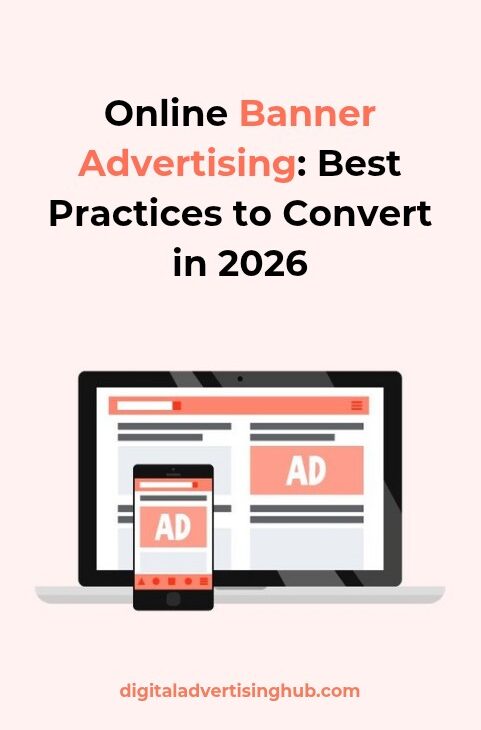
These ads appear in predefined placements such as headers, sidebars, in-content sections, and mobile screens.
The purpose is to attract attention, communicate a value proposition, and guide users toward a desired action, whether that action is clicking through to a website, watching a video, or completing a conversion later through retargeting.
While early banner ads were criticized for low click-through rates, modern banner advertising benefits from improved targeting algorithms, better creative standards, and advanced tracking infrastructure.
Platforms like Google Display Network, programmatic ad exchanges, and premium publisher networks allow advertisers to reach specific audiences at scale while controlling costs and performance benchmarks.
Understanding how online banner advertising works in 2026 requires moving beyond outdated assumptions. Effectiveness is no longer determined by clicks alone.
Metrics such as viewability, engagement, conversion lift, and frequency optimization now define success.
When executed correctly, banner ads contribute meaningfully to revenue generation, brand recall, and long-term customer acquisition.
How Online Banner Advertising Works in Practice

Online banner advertising operates through a combination of creative assets, placement inventory, bidding models, and audience targeting.
Advertisers design banners according to standardized dimensions or responsive formats, then distribute them through ad networks, demand-side platforms (DSPs), or direct publisher agreements.
Each impression is auctioned or priced based on factors such as audience quality, placement visibility, and competition.
Most banner ads today are served programmatically. This means impressions are bought in real time through automated systems that evaluate user data, contextual relevance, and advertiser bids within milliseconds.
When a user loads a webpage or app, an ad request is triggered, and the highest-value eligible banner is displayed.
This process allows online banner advertising to scale across millions of placements while maintaining targeting precision.
Pricing models vary depending on campaign goals. Cost per thousand impressions (CPM) remains the most common model, particularly for awareness-focused campaigns.
Cost per click (CPC) and cost per acquisition (CPA) models are also used, especially within managed display platforms.
The visual format of banner ads has evolved significantly. Standard static banners are still used, but HTML5 banners now dominate high-performing campaigns.
These allow animation, interaction, and dynamic content updates based on user behavior or location.
Interactive banners increase engagement rates and improve message retention, particularly on mobile devices where touch-based interaction is expected.
From a structural standpoint, online banner advertising works best when integrated into a broader funnel.
Upper-funnel banners introduce the brand and problem space. Mid-funnel banners reinforce value propositions and social proof. Lower-funnel banners retarget previous visitors with specific offers.
This layered approach improves overall efficiency and ensures banners contribute beyond immediate clicks.
Costs, Revenue, and Pricing Logic Behind Banner Ads
The cost of online banner advertising depends on multiple variables, including platform, targeting depth, creative complexity, and placement quality.
Website banner ads on small blogs or local publications may cost as little as $50 to $300 per month for fixed placements.
In contrast, high-traffic publishers or premium programmatic inventory can command CPMs exceeding $20, particularly in competitive industries like finance, SaaS, and e-commerce.
When banners are purchased programmatically, pricing is typically dynamic. Advertisers set bid ceilings, and costs fluctuate based on auction pressure.

Google Display Network, for example, allows advertisers to control spend through automated bidding strategies while optimizing for conversions or impressions.
Revenue generated from banner ads varies widely depending on monetization strategy. Publishers earn money by selling impressions directly to advertisers or through ad networks that fill inventory automatically.
High-traffic websites with strong audience demographics can generate thousands of dollars monthly from banner placements alone.
For advertisers, banner ads generate revenue indirectly through assisted conversions and directly when paired with strong landing pages and retargeting flows.
Charging for banner ads typically follows one of three models: flat-rate placement, CPM-based pricing, or performance-based pricing.
Flat rates are common for direct deals, especially for homepage or header banners. CPM pricing is standard in programmatic environments. Performance-based pricing, while less common, is sometimes used for affiliate or partnership campaigns where conversions are clearly attributable.
Whether banner ads are worth the investment depends on campaign structure. Brands that treat banners as isolated traffic drivers often underperform.
Brands that use online banner advertising as part of a coordinated acquisition system—paired with search, email, and retargeting—tend to see higher lifetime value and stronger ROI.
Banner Design, Formats, and Visual Structure
The best banner ads come in many shapes and sizes, but their structural purpose remains consistent: capture attention quickly, communicate relevance, and prompt action without overwhelming the user.
Common banner sizes include leaderboard formats (728×90), medium rectangles (300×250), skyscrapers (160×600), and mobile banners optimized for vertical screens.
Responsive banners automatically adjust to fit available placements across devices.
Visually, effective banner ads prioritize clarity over complexity. Strong contrast, legible typography, and a single dominant message outperform cluttered designs. Calls to action are explicit and action-oriented, guiding users toward the next step.
Modern banners frequently incorporate animation, but restraint is critical. Subtle motion draws attention without causing distraction. Interactive banners allow users to swipe, tap, or hover, increasing engagement time and brand recall.
These formats are particularly effective in mobile environments where traditional static banners struggle to stand out.
The purpose of a website banner extends beyond clicks. Banners reinforce brand identity, promote key offers, and establish presence across the web.
Even when users do not click, repeated exposure builds familiarity and trust. This is why banner advertising remains a core component of omnichannel strategies, especially for brands with longer sales cycles.
From a technical perspective, banners must load quickly and meet platform requirements. File size limits, animation duration, and accessibility standards all influence approval and performance.
Creating Banner Ads: Tools, Platforms, and Workflow
Creating banners in 2026 does not require advanced design skills, but it does require strategic intent.
Tools such as Google Web Designer, Adobe Express, Canva, and Figma allow users to build static and animated banners efficiently.
Among these, Canva is widely considered the easiest banner app for beginners due to its templates and drag-and-drop interface, while Google Web Designer is preferred for HTML5 banners compatible with Google Ads.
Virtual banners—digital banners designed specifically for online use—are typically created using preset dimensions aligned with ad network standards.

Designers start with a clear objective, define the message hierarchy, and adapt creatives for multiple placements.
This ensures consistency while maximizing reach.
Interactive banners are created using HTML5 or platform-native tools that support dynamic elements.
These banners respond to user input, such as hovering or tapping, and often include micro-animations or expandable sections.
Interactive formats tend to outperform static banners in engagement metrics, particularly for product demonstrations or feature highlights.
Mobile banner creation requires additional considerations. Screen size, touch interaction, and loading speed are critical. Mobile-first banner designs use vertical layouts, larger text, and simplified visuals.
Many advertisers now design banners directly within mobile-friendly platforms to ensure responsiveness across devices.
Creativity in banner advertising is driven by testing, not guesswork. High-performing campaigns rely on continuous experimentation with headlines, visuals, and CTAs.
Creative banner production is most effective when paired with performance data, allowing teams to refine designs based on real-world results rather than subjective preference.
Effectiveness, ROI, and Strategic Value in 2026
Banner ads remain effective when evaluated correctly. While click-through rates are generally lower than search ads, banner advertising excels at reach, frequency, and assisted conversions.
The question of whether banner ads are still effective often stems from outdated execution. Poor targeting, generic creatives, and lack of follow-up undermine results.
In contrast, modern online banner advertising leverages first-party data, contextual targeting, and creative personalization to deliver measurable outcomes.
From a financial perspective, banner ads are worth the investment when aligned with clear objectives.
Awareness campaigns focus on impressions and reach efficiency. Performance campaigns measure downstream conversions, often through retargeting.
When banners are integrated into a full-funnel strategy, they contribute to revenue growth even when last-click attribution undervalues their impact.
Google banner ads best practices emphasize relevance, creative quality, and optimization discipline.
Responsive display ads, smart bidding, and audience expansion features allow advertisers to scale while maintaining control.
In 2026, banner advertising is no longer about placing an image and hoping for clicks. It is about system design, and all the best banner ad examples follow that design.
Brands that treat banners as strategic assets—supported by data, creative iteration, and attribution modeling—continue to extract significant value from this channel.
Conclusion
Online banner advertising remains a foundational digital marketing channel because it adapts. Costs are flexible, formats are evolving, and effectiveness is tied directly to execution quality.
When designed strategically, banner ads support brand growth, drive conversions, and reinforce presence across the digital ecosystem.
In 2026, success with online banner advertising comes from understanding how it fits into the broader marketing system, not from chasing clicks in isolation.